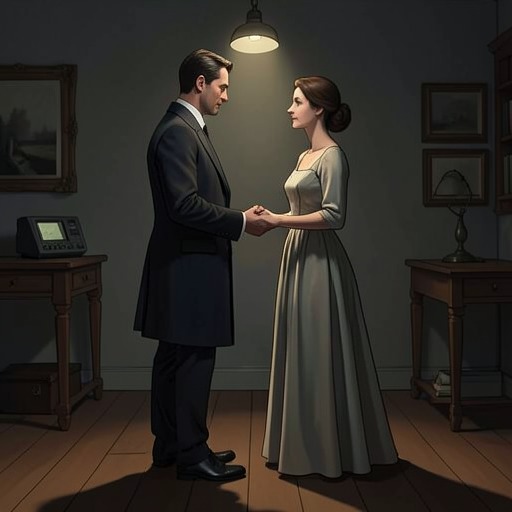
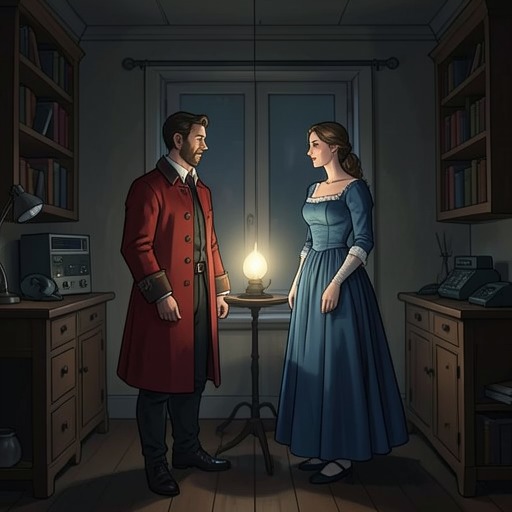
Claire
One Thousand and One NightsClaire is Tad’s scientific assistant and fellow avenging agent of Lady Love, not merely the subordinate role Tad prefers to assign her. A frequent, exuberant presence at his door and a formidable investigator in her own right, she challenges his claim to authority with a methodical approach to evidence. Their wager over science and romance turns a dispute about technique into a test of their partnership: the case advances through observation, experiment, and inference, but its resolution also exposes how little either can accomplish by treating the other as dispensable.
Identity and Introduction
Claire is introduced through Tad’s recognition of her characteristic knock. He has learned to identify her by the enthusiastic raps she makes when she arrives unannounced, a habit that has become frequent since he made the mistake, as he sees it, of feeding her. The familiar sound announces both her closeness to his daily life and the disruption she brings to his preferred order. Nan identifies the visitor, but Tad has already recognized her by ear.
That familiarity does not make Tad welcome her as an equal. He calls himself the avenging agent and describes Claire as an assistant agent—or an agent in training, a title he claims to have given her out of pity. Nan corrects him directly: Lady Love made both of them avenging agents. The distinction matters throughout their relationship. Tad’s account of Claire’s status is a self-serving hierarchy, not the arrangement established by their employer.
Methods and the Case
Claire’s investigating style is cautious, testable, and attentive to details Tad has overlooked. When Tad insists that nothing has been stolen from his house and that its door was probably opened by magic, Claire does not simply accept his certainty. She taps her chin, considers the evidence, and asks whether he brought anything home from the library. Nan’s reminder that he wanted to bring the Magic globe home points the inquiry toward the possibility that the disturbance is connected to something he handled, rather than to a conventional burglary.
The wager makes their methodological disagreement explicit. Claire accepts Tad’s challenge to determine whether science or romance is better on this case. Tad describes her approach dismissively as poetry or “gobbledygook,” while Claire names the contest as a comparison of methods. Their argument is not just that they favor different kinds of reasoning: they each claim superiority before the investigation has supplied a verdict. The case becomes the ground on which those claims must be tested.
At the Library of Love, Claire presents a necklace with a gold pendant and conducts a physical test. She moves a square, metal-like object over the gold, then takes a vial wrapped in red cloth from a wooden crate. Warning Tad to stand back, she carefully opens the vial and places one drop on the pendant. The liquid fizzes slightly; to Tad, nothing much has happened, but Claire treats that small reaction as confirmation of her suspicions. The scene distinguishes observation from interpretation. Tad sees an inconsequential fizz, whereas Claire has tested a hypothesis and understands the result as evidence.
Her explanation of the necklace’s likely provenance adds a further chain of reasoning. A merchant would have little apparent reason to sell a genuine gold item for roughly the same value in gold coin, unless it was fake, stolen, or acquired cheaply with knowledge of its illicit origin. Stolen goods could not safely be displayed beside legitimate merchandise, Claire reasons, so a seller dealing in them would need customers from elsewhere. She then asks whether the necklace had been hidden until the merchant had looked Tad over. When Tad confirms that it was, she infers that the merchant knowingly handled dishonestly obtained goods. She also identifies Tad’s alternative theory—that a thief watched the purchase and followed him to pick his pocket—as a separate hypothesis, rather than a fact established by the necklace alone. Her method is strongest when it preserves that distinction between what the clues support and what remains conjecture.
Claire is not infallible or omniscient: the investigation still requires a combination of her tests and Tad’s observations. But her attention to circumstance gives the partnership’s dispute practical stakes. A hidden necklace, a seller’s behavior, and a chemical reaction are not decorative details; together they allow her to construct and assess a plausible account of the object’s movement.
Magical Knowledge and Everyday Life
Claire’s expertise sits alongside an unconventional domestic and magical life. Tad associates her disordered hair with time spent wearing the Love goggles, mixing strange potions with Tante Iezavel, or looking at things she should not. This is Tad’s suspicious, comic reading of her habits, not an independent account of what she is doing. His suspicion that she may be “cheating” on the wager likewise reflects the strain of their rivalry: when she magicks herself to the Library of Love, he follows, unwilling to let her work beyond his sight.
A separate object reveals another side of Claire’s interests. Tad brings her Rumpelstiltskin's spinning wheel, supposing she might use it to make clothes or blankets for her Roc pets, and asks where the birds are. Claire answers with an extended account of their future adult wingspans—twenty meters—and of her research into their needs, the food obtained from local merchants, and the feeding behavior of Georgie and Porgie. She recounts that Imogene regards Georgie’s taking Porgie’s food as a natural consequence of dominance within the brood, while Claire has her own view. Tad stops following the details, but he understands that Claire is trying to return the young birds to their native environment. The episode places her concern for the Roc alongside her investigative habits: she studies particular needs, gathers relevant information, and acts on what she learns, even when Tad treats the subject as rambling.
Her attention to magic also meets a deadline far larger than the wager. After a long search in the library, Tad learns that jinn or genies are half-fairy and half something else, and that accounts describe them as mischievous, somewhat clever, unpredictable, and capable of helping or harming. One tale about a miller’s daughter and a being who spins straw into gold may concern the same jinn who deceived Della’s father, although Tad finds no reference to a lamp in that version. Claire appears in the library exhausted, her eyelids drooping; after she yawns, Tad yawns too. He explains what he has discovered, including that Della will become the jinn’s property on her twenty-first birthday, less than a day away. Claire’s investigative partnership therefore operates under immediate pressure, with research and interpretation required before the deadline.
Partnership, Conflict, and Resolution
Tad and Claire’s rivalry repeatedly turns the question of method into a question of status. Tad’s insistence that he is the avenging agent conflicts with Nan’s reminder that Lady Love appointed them both. His wager gives Claire a formal opportunity to challenge his assumption that his own approach is superior, but its competitive terms also tempt them to withhold or control information. At one point Claire says she can win even if she lets Tad in on her findings, then magicks herself away to the library; he follows her, accusing her in his own mind of trying to cheat. Their investigation is collaborative in practice even when each tries to claim the advantage.
Lady Love eventually identifies the deeper error in their contest. She reveals that she instructed the others—Pip, Sev, Nan, and Wigamus—to leave the two agents to their own devices so that they could learn from the case. She had not chosen one as more valuable or taken sides against her own servants. Claire and Tad have put themselves through an ordeal only to return to their original position, with neither acknowledged as more important than the other. Lady Love tells Claire that she cannot solve a case without Tad. The rebuke makes the wager’s real outcome relational rather than competitive: their work depends on cooperation, and a verdict that elevates one agent above the other would misrepresent how they function.
Narrative Role and Significance
Claire’s role is to make investigation a practice of testing and correction rather than a contest decided by confidence alone. Her careful handling of the gold pendant turns a faint fizz into a meaningful result; her reasoning about the hidden necklace converts a merchant’s conduct into a theory of illicit trade while still distinguishing inference from proof. Tad contributes observations and clues of his own, including the Magic globe’s image of Zaen and Della’s father entering a concealed treasure chamber with the words “Open sesame.” The case thus brings together different kinds of evidence, and the agents’ rivalry supplies a comic but consequential frame for discovering that no single method—or investigator—owns the solution.
The supernatural figures’ arguments about value echo the human dispute without making the two conflicts identical. Rumpelstiltskin calls humans unable to calculate true value, while Tante Iezavel dismisses science as childish and describes herself as someone who gives counsel to those in need. She also explains that being thought a witch is good for business. In that world, labels such as scientist, witch, agent, and assistant are claims about authority as well as descriptions. Claire’s equal appointment and effective work challenge Tad’s effort to demote her, while her experiments demonstrate that disciplined inquiry can operate amid magic without pretending that every mystery is reducible to a single person’s expertise. The partnership’s significance lies in the correction Lady Love enforces: the agents are not rivals whose worth must be ranked, but collaborators whose differing contributions matter together.